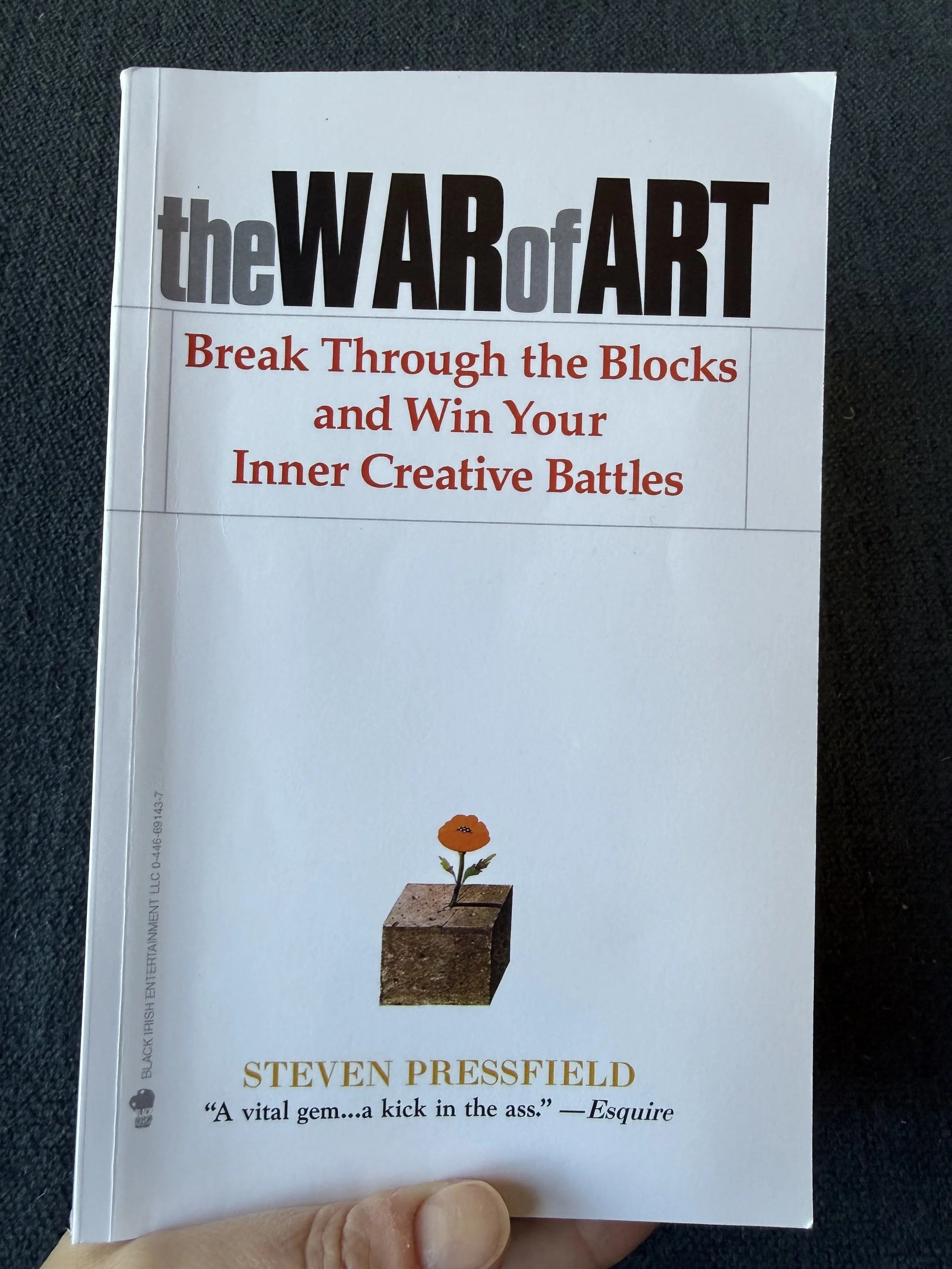
The War of Art
the summary (no spoilers)
Through reflections on Resistance and the Muse, Steven Pressfield reminds us all that when it comes to creative endeavors, we just need to do the work with consistency. Because the doing is the point.
Touchstones
The drum beat of this book is that if you wish to create something - a book, a poem, a painting, a sculpture, a piece of music - you must dedicate time to the task each day. You must make it your job. You must show up and do the work every day whether you feel like it or not (because often you won’t). This is a sentiment I have heard from other writers as well. I understand what they mean - I have been telling myself I will write a book “someday” for awhile now, and so far I have some notes on ideas but very little actual writing. I understand that I will need to accept a first draft written poorly in order to move on to a later draft worth reading. It feels difficult to find the time, and yet I know that if I really want it, I will have to prioritize.
Aside from this, there is another point on which I feel convicted - that of authenticity.
A hack, he says, is a writer who second-guesses his audience. When the hack sits down to work, he doesn’t ask himself what’s in his own heart. He asks what the market is looking for. …he’s scared to death of them or, more accurately, scared of being authentic in front of them, scared of writing what he really feels or believes, what he himself thinks is interesting. He’s afraid it won’t sell. So he tries to anticipate what the market wants, then gives it to them. …But even if you succeed, you lose, because you’ve sold out your Muse, and your Muse is you, the best part of yourself, where your finest and only true work comes from. …We must do our work for its own sake, not for fortune or attention or applause.
I must admit that there are sometimes people in my life who live in my head while I am writing, and I temper my words to soothe them. I should stop doing that.
The author leaves us with this commandment, which summarizes his thesis:
Are you a born writer? Were you put on earth to be a painter, a scientist, an apostle of peace? In the end the question can only be answered by action. Do it or don’t do it. It may help to think of it this way. If you were meant to cure cancer or write a symphony or crack cold fusion and you don’t do it, you not only hurt yourself, even destroy yourself. You hurt your children. You hurt me. You hurt the planet. You shame the angels who watch over you and you spite the Almighty, who created you and only you with your unique gifts, for the sole purpose of nudging the human race one millimeter farther along its path back to God. Creative work is not a selfish act or a bid for attention on the part of the actor. It’s a gift to the world and every being in it. Don’t cheat us of your contribution. Give us what you’ve got.
My review
This book reminded me a lot of Anne Lamott’s Bird by Bird, a book I really loved and which made me want to write. The War of Art did the same. Though some parts were a bit overwrought, the take-home message was clear and engaging. At 165 pages, it was also a fairly quick and easy read. I give The War of Art 4.5 stars.